


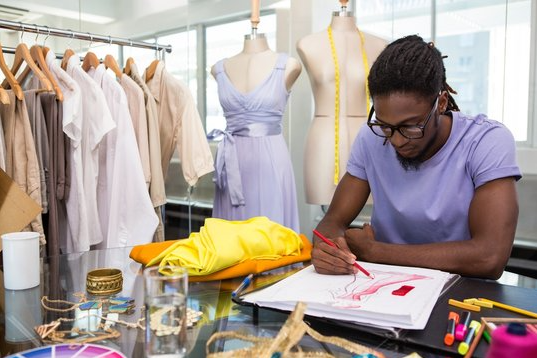
In the hands of a designer who understands the possibilities, a piece of fabric can become almost anything. It can be draped, folded, pleated, dyed, printed, reconstructed or paired with other materials to give it a new persona.
Knowing how to sew a garment is only part of the craft as a fashion designer. Contemporary techniques give designers more room to experiment with shape, texture, colour and materials, while developing the details that make their work recognisable.
Makedia Pryce-Johnson, Fashion Designer at the Jamaica Business Development Corporation’s (JBDC) Incubator & Resource Centre (IRC), explored the Wear Jamaica Fi Summa campaign and spoke with Entrepreneur Weekly about five (5) techniques that designers should have on their radar.
FASHION DRAPING AND FABRIC MANIPULATION:

Shape It, Fold It, Drape It…
“Rather than starting with a flat pattern, fashion draping allows a designer to work directly with fabric on a dress form or mannequin to create a structural three-dimensional design and elaborate pleating details”, Pryce-Johnson shares.
Working this way allows the designer to see how the fabric falls and behaves on the form, while experimenting with folds, volume and shape.
A related technique, fabric manipulation, changes the appearance or texture of the material itself.
“This includes techniques that change the nature of the fabrics used. They create innovation and interest through adding various textures and tactile contrasts,” Makedia explained.
Smocking, pleating and folding are among the techniques that can be used to transform the surface of a fabric and make texture part of the design.
She sees elements of this experimentation among the designers in Wear Jamaica Fi Summa. Young Addiction, for example, uses draping in the construction of dresses and gowns.
UPCYCLING:
What’s Left…
Upcycling gives designers an opportunity to rethink leftover material and existing garments. A scrap of fabric does not necessarily have to be waste. According to the JBDC Fashion Designer, the technique “relies heavily on the use of leftover scraps during cutting to make fashion accessories.”
“An existing garment could even be reconstructed to create a whole new design,” she added.
It means the creative process can continue even after the garment has been cut. Leftover material can find another purpose, while something that already exists can become the starting point for an entirely different piece.
ARTISANAL CRAFTMANSHIP:
Bring The Hand Back into Fashion…
Modern fashion does not have to leave traditional craftsmanship behind. Artisanal craftsmanship brings the two together.
“This is when we merge your basic garment construction with hand crafted details and surface designs like embroidery and block printing,” Pryce-Johnson explained.
INCORPORATING NATURAL/FOUND OBJECTS:

Wood, Beads, Gems…
Designers can also venture beyond textiles altogether. There are already examples among the Wear Jamaica Fi Summa designers.
“Complete garments and fashion accessories can be embellished with accessible found objects like wood, beads and gems to add interest and visual appeal,” Makedia explained. “Young Addiction incorporates wooden beads and other accessible found items in her garment pieces.”
Lannaman Gems, meanwhile, uses precious stones found in nature to create jewellery pieces. The material itself can therefore become part of what makes a design interesting, whether it is stitched into a garment, used as an embellishment or turned into an accessory.
MIXING AND LAYERING COLOURS AND PATTERN:
Colour the Summer…
Sometimes the statement is in the construction. Sometimes, it is in the colour. Mixing patterns, layering colours and experimenting with colour blocking can give a garment personality before any additional embellishment is introduced.
“Utilising vibrant colours and playing around with bold patterns add interest and personality to a piece,” Makedia said. “It creates a bold statement, promoting confidence.”
That confidence is evident in some of the collections being highlighted through Wear Jamaica Fi Summa.

Pryce-Johnson points to Broadtail Designs, which uses bold patterns and vibrant colours across its swimwear and dresses, layering them with statement cover-ups and outerwear.
The Clothing Manipulator also experiments with colour blocking as a core principle in its designs.
These designers are not necessarily using the same technique in the same way, and that is precisely the point. Technique gives a designer another tool; what they do with it becomes part of their creative identity.
FROM CONCEPT…JBDC’s FASHION INCUBATOR
Of course, knowing what you want to create and being able to execute it are two different things. Some of these techniques can be explored and executed using the resources available at JBDC’s Fashion Incubator.
The facility is equipped with industrial straight-stitch and overlock machines which, according to Makedia, “can effectively execute fabric manipulation on fabric to enhance designs.”
The machinery also gives designers flexibility in the types of fabric they can work with.
“They can also be used to sew a wide range of fabrics from sheer cover-ups, stretch fabrics used to make swimwear, and non-stretch material suitable for constructing structural pieces,” she said.
For designers experimenting with fashion draping, the incubator has a dress form that allows them to manipulate and develop the fabric directly on the form.
The facility also provides buttonhole and button-tack machines to support garment finishing. And designers interested in artisanal techniques have room to explore those too.
“There is also an area designated for the use of artisanal craftmanship (Artisanal Hub) through fabric dyeing and printing techniques,” Pryce-Johnson pointed out.
The value of having these resources in one space is that designers can move beyond knowing about a technique and begin experimenting with how it works in their own designs.
JBDC is inviting you to visit its Fashion Incubator located inside the Incubator & Resource Centre (JBDC) at Garmex Freezone in Kingston or get more information at www.jbdc.net. It’s one of four incubators that creatives can take advantage of. But if you are interested in shopping from the Wear Jamaica Fi Summa collection made by Jamaican designers, check out www.thingsjamaicanshopping.com.


