


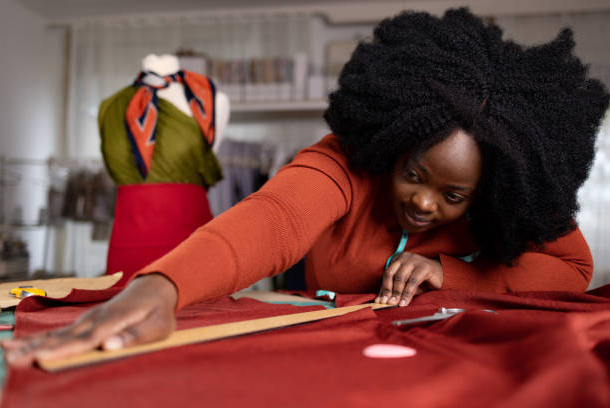
The perfect stitch goes beyond talent because Jamaica has no shortage of fashion talent. But turning that creativity into a sustainable fashion business requires much more than being able to sew a beautiful garment.
Can the designer make enough pieces to meet demand? Can they maintain quality and consistency? Is the business structured to support growth? Who is the target customer? Where will that customer find the product? And, perhaps most importantly, can the designer turn the creative idea into something that generates profit?
These are some of the questions that fashion entrepreneurs must confront as they move from creating individual pieces to building businesses. For the Jamaica Business Development Corporation (JBDC), answering them means looking at the fashion entrepreneur as more than a designer.
It means looking at the entire process, from developing the idea and creating the garment to establishing production systems, understanding the market and building a brand that people want to buy.
For Robert Hall, a Fashion Designer at the JBDC’s Incubator and Resource Centre, one of Jamaica’s biggest opportunities lies in what already makes the local fashion industry different. “You know, the world is open and the higher availability of clothing across multiple geographies, people want things that are original.”

Jamaican designers may not have the capacity for mass production enjoyed by larger international fashion markets, but that does not necessarily have to be a disadvantage.
“We are way less automated here in Jamaica. We are not mass in terms of what we’re able to do, then you literally have an opportunity because then a lot more of what we do as designers are more, let’s say, original handmade.”
The opportunity, however, comes with a challenge. Originality has to be matched by the ability to deliver. This is where the JBDC Fashion Incubator becomes an important part of the equation. The facility was developed to support designers who may have the talent and the ideas but lack the professional space, equipment or production capacity needed to take those ideas further.
The incubator provides access to industrial straight-stitch machines, industrial sergers, buttonhole and button-tuck machines, a hammer, a flat-lock machine and a large cutting table, among other equipment.
A designer preparing a large order, for example, can use the cutting table to cut pieces in bulk rather than attempting to manage the process on a smaller home setup. Access to industrial machinery also allows entrepreneurs to carry out different aspects of garment construction and finishing more efficiently.
And the facility is not limited to one type of fashion product. “Everything,” Robert said when asked what can be produced at the incubator. That ranges from basic T-shirts and school uniforms to tailored pieces, wedding dresses and more complex garments.
The support is intended to extend beyond a single visit or a single production challenge. Robert described it as a process in which the team walks alongside entrepreneurs as they develop their businesses.
“We’re walking with you through the whole process, basically,” he said. “We literally come alongside you and we begin to actually, you know, one, help you with, you know, get to becoming aware of all the different things that are happening in front of you. And then also, how do we now, plug those holes, you know, as we go along.”
From Creativity to Commerce
The reality is that a designer needs a roadmap to profitability. That means identifying the target market, understanding where those customers are and developing a collection that makes sense for them. It also means thinking about sourcing, fabric availability, patterns, construction, samples and fittings before moving into production.
The objective is to ensure that the creative vision is supported by a business model.

This is where the conversation moves from production to positioning. Enters Janine Fletcher-Taylor, Manager of the Marketing Services Unit at the JBDC…
A designer cannot effectively market to everyone. The collection needs a clearly defined customer, and that customer should influence everything from the design and imagery to the places where the product is sold.
“There must be clarity around who the target market is. Because the fashion industry is segmented and diverse.”
If a collection is aimed at the resort market, for example, the designer needs to understand which boutiques, gift shops and other retail channels serve that customer. If the collection targets a different segment, the route to market changes.
The same principle applies to branding. A designer must be able to communicate what the brand represents and why a customer should choose it. “What is your brand known for or how have you positioned the brand? All that is important for the marketer to understand so that you can position properly.”
Fashion is visual, which means the way a product is presented can be just as important as the product itself. Lookbooks, catalogues, photography, video, fashion shows, endorsements and collaborations can all help place a collection in front of the right audience.
There is also an opportunity for designers to build on something Jamaica already possesses: a distinctive cultural identity. Jamaican fashion draws from a rich mix of influences, including bandana, batik, African influences, Jamaican street culture and the colours associated with the national identity.
According to Janine, there is already a growing international appetite for elements associated with Jamaican fashion and culture. “What I have seen is a plethora of persons looking at the mesh, the marina style with the black, green, gold and red, the Rastafarian African influences in terms of patterns and uses of colour.”
For Jamaican fashion to become a stronger commercial industry, however, designers must be prepared when that demand comes. They need reliable production. They need consistent quality. They need to understand their customers. They need to know their costs and pricing. They need a brand that communicates value. And they need to understand how and where their products will be sold.
JBDC’s Fashion Incubator is giving entrepreneurs access to equipment, workspace and technical support. The wider support available through the agency helps entrepreneurs think through their markets, positioning and opportunities.
Visit www.jbdc.net to find out more about the JBDC’s fashion Incubator. And if you want to wear something that’s Made in Jamaica, then Things Jamaican’s Wear Jamaica Fi Summa campaign may excite you. Check it out at www.thingsjamaicanshopping.com.


